 Compound
Compound liquidation settles debt after a collateral shortfall or qualifying v2 market deprecation
Compound liquidation becomes available when outstanding debt exceeds the limit that market rules assign to collateral. In v2, a liquidator repays a permitted debt amount and receives collateral cTokens, which represent supplied assets. Compound III instead takes collateral into the protocol and clears the account's debt through absorption. A qualifying v2 market deprecation state also allows liquidation without an account shortfall.
In short: A borrowing restriction doesn't always imply liquidation eligibility, and v2 market deprecation can permit liquidation without an account shortfall.
A shortfall changes the account's liquidation eligibility
Debt must exceed the collateral limit for ordinary liquidation eligibility. Equality alone doesn't create a shortfall. The calculation compares debt with collateral after applying the relevant asset factors. Those factors discount collateral's value for liquidation eligibility, so liquidation can become available while its unadjusted value still exceeds debt.
Oracle prices determine the values that the contracts compare. Falling collateral prices, rising borrowed-asset prices or accruing interest can move an account across the threshold even when its collateral quantities stay unchanged and no new borrowing occurs. Governance changes can also alter the boundary. For unchanged collateral quantities, lowering the factor that governs liquidation reduces the supported debt value. An interface's displayed token count can't establish whether an account remains within the limit. The calculation also needs the applicable prices, factors and debt balance.
Separate borrowing limits and v2's deprecation exception
Compound III uses separate factors for new borrowing and liquidation. Its higher liquidation collateral factors leave a buffer after the account loses borrowing capacity. An account can therefore fail the borrowing test while still passing the liquidation test. Reducing only the borrow collateral factor doesn't move the separate liquidation boundary.
Under v2's deprecation rule, liquidation can proceed without an account shortfall. The borrowed market qualifies when its collateral factor is zero, borrowing is paused and its reserve factor equals 100%. That path also bypasses the ordinary close-factor cap. Repayment still can't exceed that market's outstanding debt, and the other execution checks remain.
Compound v2 repayment transfers collateral cTokens to the liquidator
The close factor bounds repayment against one borrowed asset in an ordinary v2 liquidation. It doesn't cap the account's combined debt across every asset. The liquidator calls liquidateBorrow on the borrowed asset's cToken contract and identifies the collateral cToken market. Both markets must use the same Comptroller, the contract that enforces lending risk rules. Liquidation fails if seizure is paused or the borrower lacks enough cTokens in the chosen collateral market to cover the calculated seizure.
For an ERC-20 debt market, the liquidator needs repayment tokens and an allowance for the borrowed cToken contract, while v2's native-asset market accepts repayment value with the liquidation call. The liquidation doesn't require the borrower's signature. Within successful execution, repayment reduces the debt and seizure removes collateral cTokens. The liquidation incentive determines total seizure, while an applicable protocol seize share directs part of that value into reserves.
Compound III absorbs collateral before offering it for sale
An eligible account's entire collateral position in the selected Compound III market passes to the protocol during absorption. The caller invokes absorb and doesn't fund a v2-style debt repayment. The protocol's base-asset reserves fund settlement.
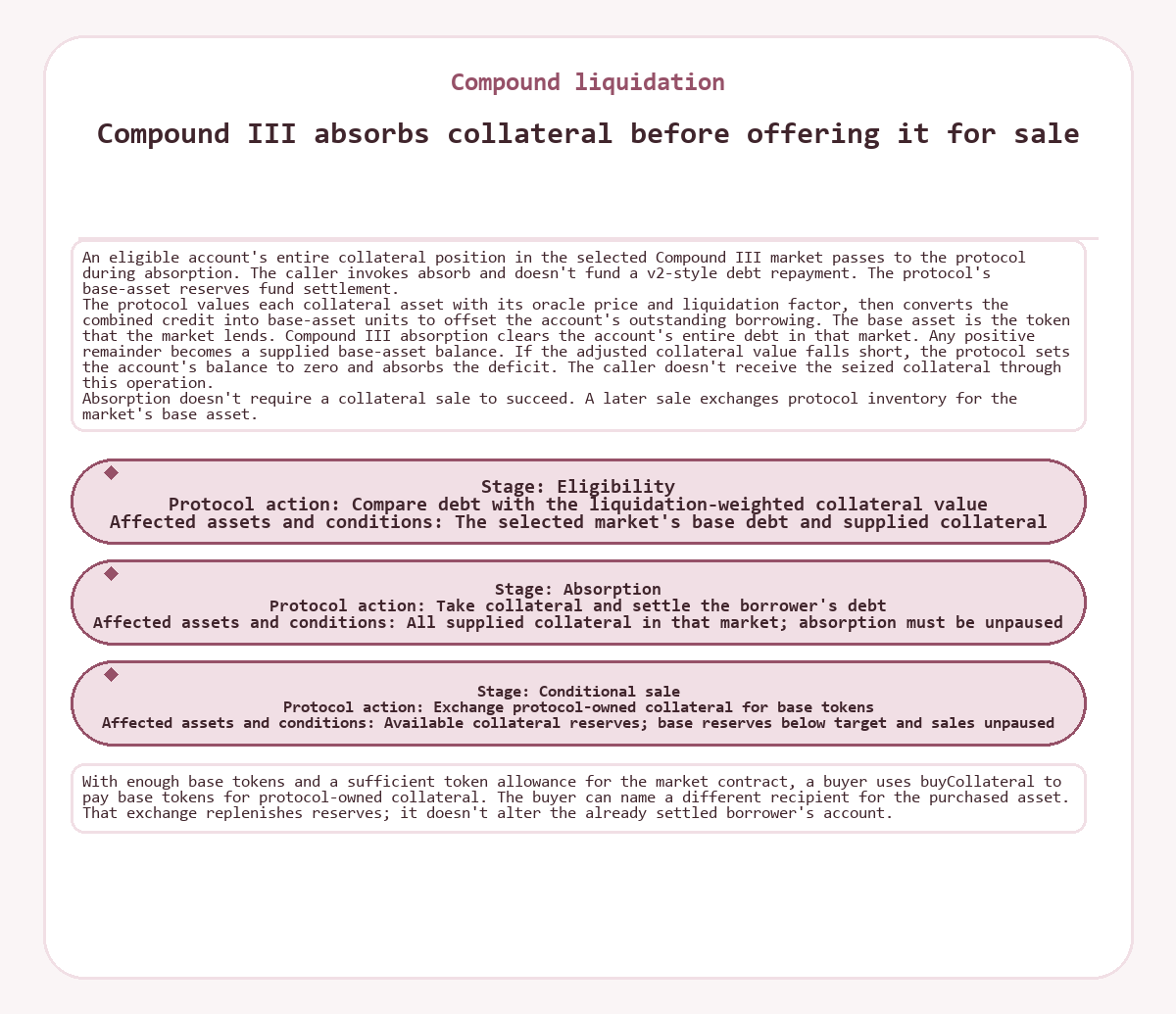
The protocol values each collateral asset with its oracle price and liquidation factor, then converts the combined credit into base-asset units to offset the account's outstanding borrowing. The base asset is the token that the market lends. Compound III absorption clears the account's entire debt in that market. Any positive remainder becomes a supplied base-asset balance. If the adjusted collateral value falls short, the protocol sets the account's balance to zero and absorbs the deficit. The caller doesn't receive the seized collateral through this operation.
Absorption doesn't require a collateral sale to succeed. A later sale exchanges protocol inventory for the market's base asset.
| Stage | Protocol action | Affected assets and conditions |
|---|---|---|
| Eligibility | Compare debt with the liquidation-weighted collateral value | The selected market's base debt and supplied collateral |
| Absorption | Take collateral and settle the borrower's debt | All supplied collateral in that market; absorption must be unpaused |
| Conditional sale | Exchange protocol-owned collateral for base tokens | Available collateral reserves; base reserves below target and sales unpaused |
With enough base tokens and a sufficient token allowance for the market contract, a buyer uses buyCollateral to pay base tokens for protocol-owned collateral. The buyer can name a different recipient for the purchased asset. That exchange replenishes reserves; it doesn't alter the already settled borrower's account.
What determines the collateral loss from liquidation?
V2's repayment amount, oracle prices and liquidation incentive determine the seized collateral value; Compound III takes the account's entire collateral position in the selected market. In v2, the liquidation incentive increases the collateral claim relative to the debt repaid. The seized cToken quantity also depends on the collateral market's exchange rate. A protocol reserve share reduces the liquidator's receipt while leaving the borrower's total seizure unchanged.
Compound III applies asset-specific liquidation factors when crediting the absorbed account. A lower collateral price reduces both liquidation support and the value available for that credit. The buyer's discount combines storeFrontPriceFactor with that asset's liquidation factor. A quote doesn't establish available inventory. Buyers can set minAmount to reject insufficient collateral output. That minimum uses collateral-token units; payment uses base-token units. Transaction gas adds to the cost that the caller pays.
Repayment and collateral additions have bounded effects
Before settlement, repayment lowers debt and additional eligible collateral increases the weighted collateral value. These actions change the shortfall calculation. They don't reverse an absorption that has already executed, and extra collateral doesn't cancel v2's deprecation-based liquidation permission.
In Compound III, supplying the base asset repays borrowing first; supplying a supported collateral asset increases collateral instead. Supply reverts while paused, and adding collateral reverts if that asset's total supply in the market would exceed its cap. The funding address must approve the market contract to spend the requested supply amount. Adding a different asset doesn't repay base debt. An intervention removes ordinary eligibility only if the resulting account satisfies the liquidation threshold under the prices and parameters that then apply.
Which records confirm the account's state after liquidation?
Successful liquidation event logs and updated account balances identify the debt settlement and collateral changes. V2's LiquidateBorrow event records actual repayment and seized cTokens. Remaining debt can persist in that borrowing market or other borrowed markets, so one event doesn't establish that the whole account has no debt.
Compound III emits AbsorbCollateral and AbsorbDebt. The latter's basePaidOut includes extinguished debt as well as any surplus credit; it isn't the borrower's wallet payout. The account's present base balance identifies any remaining supply claim. Before ordinary shortfall-based liquidation, enough repayment can remove eligibility without surrendering collateral. After Compound III absorption, withdrawal concerns any remaining base-asset claim; it can't restore the seized collateral position.
What to know about Compound liquidation
When can liquidation execute after a shortfall appears?
Liquidation can execute when a submitted transaction satisfies the contract's eligibility and execution checks. Crossing the threshold makes an account eligible; it doesn't schedule settlement for a fixed later time. Prices, accrued debt and market state can change between an earlier balance check and the transaction's execution.
Can the borrowing address liquidate its own v2 debt?
The v2 liquidation function rejects a call when the liquidator and borrower are the same address. The borrower can use ordinary repayment to reduce debt instead. Repayment doesn't grant the liquidation incentive or seize collateral, and this restriction concerns the liquidation call rather than the ability to repay an outstanding loan.
Is receiving seized cTokens the same as receiving the underlying collateral?
Receiving seized cTokens gives the v2 liquidator a claim on the collateral market's underlying asset. Redeeming that claim is a separate operation that requires sufficient market cash. A successful liquidation therefore doesn't establish that the liquidator already holds the underlying tokens, or that immediate redemption can succeed.
What happens if one account in an absorption batch isn't liquidatable?
Compound III's absorb call reverts if a listed account fails its liquidation eligibility check. The failed call rolls back the batch's changes, including earlier absorptions within that call. This makes each account's execution-time eligibility relevant; an earlier check doesn't preserve eligibility when prices or balances subsequently change.
Will Compound III liquidator points automatically reimburse gas?
The absorb function records liquidator points without automatically transferring a gas reimbursement. Its records track successful calls, absorbed accounts and an approximation of gas spending for the designated absorber address. Those entries don't themselves represent spendable base tokens or establish a fixed compensation amount.
Does liquidation seize tokens that remain in my wallet?
V2 liquidation can seize the borrower's collateral cTokens, including cTokens visible in a wallet. Compound III absorption takes the collateral recorded in that market. The liquidation functions don't seize unrelated token balances held in the wallet. Wallet holdings also don't automatically contribute to collateral support; v2 uses cToken balances from entered markets, while Compound III uses its recorded collateral balances.
Are a borrower's liquidation details visible publicly?
Liquidation events expose the affected account address and amounts in public transaction logs. V2 records repayment and seized cTokens, while Compound III records absorbed collateral and debt settlement. A wallet address doesn't necessarily identify a person.